Last Updated: November 13, 2026
Quick Summary
To select the right sediment filter cartridge, first diagnose your sediment with a jar test, paper towel test, or toilet tank inspection, then match the micron rating to the particle size and choose pleated, spun, or melt-blown media. Confirm the cartridge dimensions fit your housing and size it for your home’s peak flow rate.
- Sand and grit settle within minutes in a jar test, while silt and clay stay cloudy for hours.
- Use 1-5 micron for fine silt and clay, 10 micron for rust and fine sand, and 20 micron for sand and grit.
- Pleated filters use surface filtration for high flow and easy inspection, best as a first stage.
- Standard cartridge sizes include 4.5″ x 20″, but measure your housing rather than assuming.
- Rapid clogging usually means the rating is too fine, so step up to a coarser first stage.
Table of Contents
- Start With Your Water: Diagnosing Sediment Before You Buy
- Sediment Filter Micron Size Chart: Matching Ratings to Particles
- Pleated, Spun, or Melt-Blown: Choosing the Filter Media
- Sediment Filter Cartridge Size: Dimensions, Housings, and Flow Rate
- How to Select the Right Sediment Filter Cartridge for Well Water
- Sediment Filter Cartridge Replacement Frequency and Troubleshooting
- Analyze Your Water and Build a Filtration System That Lasts
- Frequently Asked Questions
Start With Your Water: Diagnosing Sediment Before You Buy
The most common mistake in choosing a sediment filter cartridge is buying before you know what you’re filtering. Homeowners often replace cartridge after cartridge when they guess at particle size instead of measuring it. Diagnosing your sediment first saves money and frustration.
Sediment is any suspended solid that travels in your water: sand, silt, rust flakes, clay, and dirt. Each behaves differently in a filter.
Here’s how to identify what you’re dealing with:
- The jar test. Fill a clear glass jar with tap water and let it sit overnight. Sand and grit settle fast to the bottom. Silt and clay stay cloudy and settle slowly. Rust leaves a reddish-brown film.
- The paper towel test. Run water through a white paper towel for a minute. The color and grit left behind tell you a lot: rust reads orange, silt reads gray-brown.
- The toilet tank test. Lift the lid on a tank that hasn’t been cleaned recently. Sediment collects there and shows you exactly what’s arriving at your fixtures.
What Sediment Type Tells You About Micron Needs
Sand and grit are large particles that a coarser rating catches easily. Silt and clay are finer and demand a tighter rating. Rust sits somewhere between, and its flakes vary in size. Match the rating to the particle, not to a guess.
The man is American.
Sediment Filter Micron Size Chart: Matching Ratings to Particles
A micron is one millionth of a meter. A micron rating on a sediment filter cartridge tells you the size of particle the filter is designed to capture. Lower numbers catch finer particles; higher numbers catch coarser ones. But a rating alone is meaningless without knowing what’s in your water. Use this chart as a starting point, then apply the diagnostic steps below to refine your choice.
|
Micron Rating |
Catches |
Best For |
Trade-off |
|---|---|---|---|
|
1-5 micron |
Fine silt, clay, rust |
Polishing after a coarse stage |
Clogs fastest, lowest flow |
|
10 micron |
Rust flakes, fine sand |
General well water sediment |
Middle ground |
|
20 micron |
Sand, grit, larger debris |
First-stage protection |
Lets fine silt through |
|
50 micron+ |
Coarse sand, debris |
Heavy sediment pre-filter |
Not a final filter |
A Practical Diagnostic Process for Identifying Sediment
Choosing a micron rating by guesswork leads to rapid clogging or poor filtration. Follow this process to match the rating to your actual sediment:
- Collect a sample. Fill a clear glass jar with water from the tap or wellhead and let it sit overnight. Observe the settling pattern: sand and grit settle within minutes, silt and clay remain cloudy for hours, and rust leaves a reddish-brown film on the glass.
- Perform a paper towel test. Run water through a white paper towel for one minute. The color and texture of the residue indicate sediment type: orange-brown suggests rust, gray-brown suggests silt, and gritty particles indicate sand.
- Inspect the toilet tank. Remove the lid from a tank that hasn’t been cleaned recently. Sediment collects there and shows exactly what’s arriving at your fixtures.
- Distinguish visible particles from fine turbidity. If the water is cloudy but no particles settle, you likely have fine silt or clay that requires a tighter rating (1-5 micron). If visible particles settle quickly, a coarser rating (20-50 micron) may suffice as a first stage.
- Confirm with a water test. For persistent or unknown sediment, use a home test kit or professional lab analysis to measure turbidity and sediment load. This data removes guesswork and ensures you select a rating based on measured particle size distribution.
Watch out: Relying solely on visual inspection can miss fine sediment that passes through a coarse filter and clogs downstream equipment. Always combine field tests with a water analysis when sediment is heavy or variable.
For help matching a rating to your specific water, our guide on how to choose a micron rating for well water walks through the 5, 10, and 20 micron options in more detail.
Pleated, Spun, or Melt-Blown: Choosing the Filter Media
Filter media determines how a cartridge captures particles, and the three main types work on different principles. Choosing the right one requires understanding not just how they filter, but how they fit your system, maintenance habits, and water conditions.
Pleated filters use surface filtration: particles collect on the outer surface of a folded sheet. They hold more dirt before clogging and are easy to inspect. Spun and melt-blown cartridges use depth filtration: particles are trapped throughout the thickness of the media, which catches more fine material but makes the cartridge harder to clean.
Here’s the honest comparison:
- Pleated: High flow, cleanable surface, best as a first stage. Watch out: fine silt can slip through a coarse pleat.
- Spun: Good fine-particle capture, lower flow, not cleanable. Best for polishing after a pleated stage.
- Melt-blown: Similar to spun with graded density, good for variable sediment loads. Shorter lifespan under heavy grit.
Compatibility, Materials, and Water-Safety Considerations
Beyond filtration principle, the cartridge must be compatible with your housing and water conditions. Check these factors before ordering:
- Housing fit: Cartridge dimensions (length and diameter) must match your housing exactly. Standard sizes include 4.5″ x 20″, but measure your housing rather than assuming.
- Temperature and pressure limits: Check the manufacturer’s stated operating temperature and pressure limits for the cartridge before installing it.
A Decision Tree for Media Selection
Use this framework to choose the right media for your situation:
- If your primary goal is high flow and easy inspection (e.g., first-stage whole-house filtration), choose pleated.
- If you need fine particle capture and have low turbidity (e.g., polishing after a coarse stage), choose spun.
- If sediment load varies and you want graded filtration, choose melt-blown.
- If your system has space constraints or requires a specific housing, verify cartridge dimensions and end-cap configuration before selecting media type.
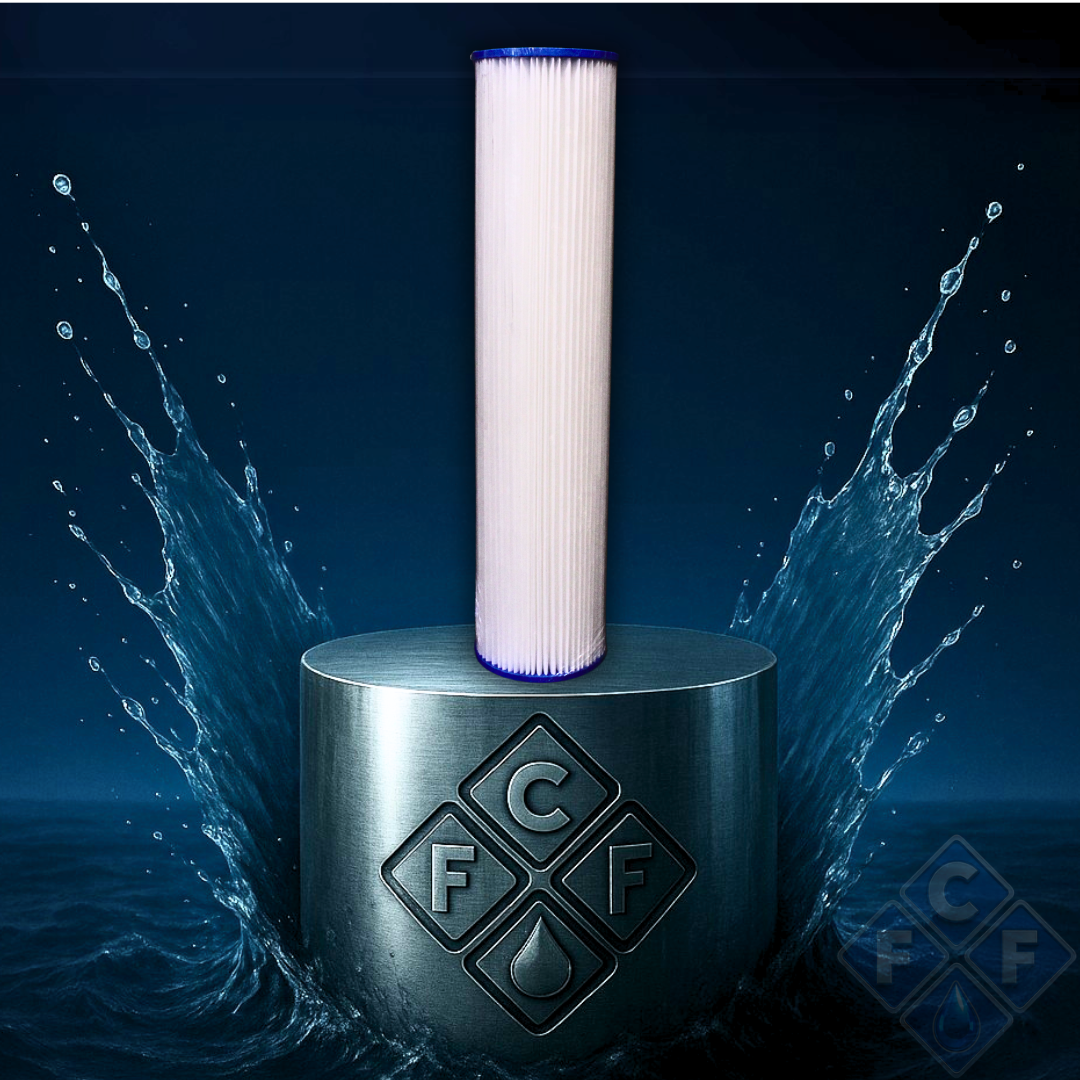
Our Alpha Sediment Cartridge is a 20 micron pleated cartridge sized at 4.5″ x 20″ that filters dirt, sand, silt, and clay.
The man is American.
Sediment Filter Cartridge Size: Dimensions, Housings, and Flow Rate
Sediment filter cartridge size must match your housing exactly, and the housing must match your system’s flow rate. A cartridge that’s too small for peak demand will choke flow; one that’s too large wastes capacity.
Check three numbers before ordering:
- Length and diameter. Standard cartridges come in common sizes such as 4.5″ x 20″. Measure your housing, don’t assume.
- Micron rating and media, which we covered above.
- Peak flow rate. Match the cartridge’s rated flow to your home’s peak demand, not its average. A second bathroom or an irrigation line changes the math.
Pressure drop rises as a cartridge loads with sediment. Size for peak flow and acceptable pressure loss, not just the day-one number. To calculate your system’s flow rate, our step-by-step guide on calculating flow rate for water systems uses the GPM formula.
How to Select the Right Sediment Filter Cartridge for Well Water
Well water carries more variable sediment than treated municipal supply, so selection starts with testing. A lab panel or a home test kit identifies turbidity and sediment load, and that data drives the rating.
Follow this decision path:
- Diagnose the sediment with the jar and towel tests.
- Pick a rating from the chart above, starting coarser than you think you need.
- Choose media based on whether you want surface or depth filtration.
- Size the housing to your peak flow.
- Stage coarse to fine if sediment is heavy: a 20 micron pleated first, then a finer cartridge downstream.
If sediment is a persistent problem beyond cartridge selection, our guide on 7 ways to treat well water for sediment covers filtration systems and maintenance schedules. Custom Fabricated Filters LLC builds stainless steel filtration systems with full-port plumbing design, which supports higher flow performance.
Sediment Filter Cartridge Replacement Frequency and Troubleshooting
Replacement frequency depends on sediment load, not a calendar. A cartridge under heavy grit may need changing monthly; a light load may last several months. Watch for the signals:
- Reduced water flow at fixtures
- Pressure drop across the housing
- Visible sediment returning downstream
- A cartridge that looks loaded when you inspect it
Rapid clogging usually means the rating is too fine for the sediment load. Step up to a coarser first stage. Recurring sediment after a fresh cartridge points to a source problem upstream. Our troubleshooting guide for well water filtration issues walks through pressure drops, odors, and filter failures step by step.
For a combined sediment and carbon stage, the Alpha-ONE Cartridge is a dual-stage (sediment/carbon) cartridge.
Analyze Your Water and Build a Filtration System That Lasts
Cartridge selection is one decision inside a larger system. Get the diagnosis right, match the rating and media to your sediment, and size the housing for peak flow, and the cartridge does its job without constant replacement.
That’s the challenge most homeowners face: cartridges that fail early because the housing and system underneath them were never built for the water. Custom Fabricated Filters LLC offers 100% surgical-grade stainless steel construction, full-port plumbing design for higher flow performance, and upgradeable filtration stages. Systems are built by master plumbers and designed through the C.L.E.A.R.™ Water Intelligence System.
Get started with Custom Fabricated Filters LLC and build filtration infrastructure that lasts.
Frequently Asked Questions
How do I know what size sediment filter cartridge I need?
Measure the inside diameter and length of your existing housing, then match those dimensions to the cartridge listing. Common whole-house sizes include 4.5 inches by 20 inches, but always confirm your housing model. Also check the micron rating and flow rate your system supports. If you are unsure, take a photo of the housing label and contact the manufacturer before ordering.
Which is finer, a 5-micron or 20-micron sediment filter cartridge?
A 5-micron cartridge captures particles down to 5 microns, so it is finer than a 20-micron cartridge. Finer filters remove more sediment but clog faster and can reduce water pressure. For well water with visible sand or grit, start with a 20-micron pre-filter and add a finer stage downstream if needed. Match the rating to your actual particle size rather than defaulting to the smallest option.
How often should I replace a sediment filter cartridge?
Replacement depends on sediment load, water use, and micron rating. A reasonable starting point is every 3 to 6 months for whole-house sediment cartridges, but high-sediment well water may require monthly changes. Watch for reduced water flow, pressure drop, or visible discoloration. Keep a log of install dates and change the cartridge when flow drops noticeably, not on a fixed calendar alone.
How do I choose a sediment filter cartridge for well water?
Test your well water first to identify sediment type and particle size. If you see sand or grit, use a 20-micron pleated cartridge as a pre-filter. For finer silt or clay, add a second stage with a smaller micron rating. Confirm the cartridge fits your housing and supports your peak flow rate. A staged approach protects downstream carbon filters and keeps pressure stable.